
September 4, 2026
A hospital renovation company modernizes clinical and public spaces inside a working medical facility, often while patients are being treated a few doors down. In Orlando, that work rarely has to start with a demolition crew. Engineered Group renovates healthcare interiors by refinishing the surfaces you already own, walls, doors, elevator cabs, columns, and casework, using architectural films that go on in days rather than weeks. The building keeps running, and the space still looks new.
This guide explains what a hospital renovation company does, why occupied facilities increasingly choose refinishing over replacement, how the right method lowers infection risk during the work, and what Orlando facility managers should look for before they sign a contract.
Key Takeaways
- A hospital renovation company can modernize interiors without demolition by resurfacing walls, doors, elevators, and casework in place.
- Refinishing keeps the facility open, which matters when construction dust is a documented infection risk for vulnerable patients.
- Engineered Group reports savings of up to 60 percent versus tearing out and replacing a surface, with an interior finish life of about 12 years.
- Architectural films used in healthcare are nonporous, carry an anti-microbial surface on door products, and hold a Class A fire rating.
- In Orlando, look for a 3M authorized installer with healthcare references, an infection-control plan, and finishes that clean with hospital-grade protocols.
What does a hospital renovation company actually do?
United States spending on health care construction ran at about 6.3 billion dollars in July 2026 alone, according to U.S. Census Bureau data compiled by the Federal Reserve. Much of that budget never goes toward new buildings. It goes toward updating the hospitals already in service, and that is where a hospital renovation company earns its place.
The scope splits into two lanes. General contractors handle structural and mechanical work, new wings, patient-room layouts, and code upgrades. Finishing specialists handle the surfaces people actually see and touch. Engineered Group works in the second lane. As an architectural finishes company serving Orlando, it resurfaces walls, doors, elevator interiors, columns, and millwork so a dated corridor or lobby reads as fully renovated without the mess of a rebuild. For a hospital, that means the public face of the building, the healthcare spaces patients and families remember, can be refreshed on a predictable schedule.
Why renovate an occupied hospital instead of replacing surfaces?
The median average age of plant for United States hospitals reached roughly 11.5 years in 2015, up from 8.6 years in 1994, according to Health Facilities Management, the publication of the American Society for Health Care Engineering. Average age of plant is a financial measure of how current a facility is, and a rising number signals that hospitals have struggled to fund the capital work their buildings need.
That pressure is exactly why resurfacing has become a practical answer. Replacing wall panels, casework, or an elevator interior means demolition, new materials, longer schedules, and a closed area that generates no revenue. Refinishing the same surfaces avoids most of that. Engineered Group, founded in 2002 and run by veterans Mike DeForest and Mark Ecker, built its model on this idea of value engineering: keep the substrate, change the surface, and let the department stay open. The company reports that clients typically save up to 60 percent on an architectural finishes project compared with a full tear-out, with a finished interior that lasts about 12 years.
How do hospital renovations protect patients from infection risk?
Hospital construction and renovation are an independent risk factor for invasive fungal infection, and the overall mortality of construction or renovation associated fungal infection is approximately 50 percent, according to a peer-reviewed review in Clinical Infectious Diseases. The cause is simple and dangerous: demolition and cutting release dust and Aspergillus spores into the air, and immunocompromised patients breathe them in.
Infection is already a heavy load on hospitals. On any given day in 2023, about 1 in 38 hospitalized patients had at least one healthcare-associated infection, per the Centers for Disease Control and Prevention. A renovation method that adds airborne dust adds risk on top of that baseline.
Refinishing in place changes the equation. The work happens on the existing surface with no demolition, no construction dust, and no VOCs, so a wing can keep operating during the project. The finishes matter too. Films used on refinished commercial doors carry an anti-microbial surface and a Class A fire rating, and the 3M Di-Noc architectural films are nonporous and wipe clean with a non-abrasive cleaner or plain hot water, which fits hospital cleaning protocols. None of this removes the need for an infection control risk assessment, and a serious hospital renovation company will still plan the containment. Starting with a dustless method simply means there is far less to contain.
Which hospital surfaces can be refinished without demolition?
The United States generated about 600 million tons of construction and demolition debris in 2018, more than twice the volume of municipal solid waste, according to the U.S. Environmental Protection Agency. Every square foot a hospital refinishes instead of demolishing keeps material out of that waste stream and out of a dumpster in the parking lot.
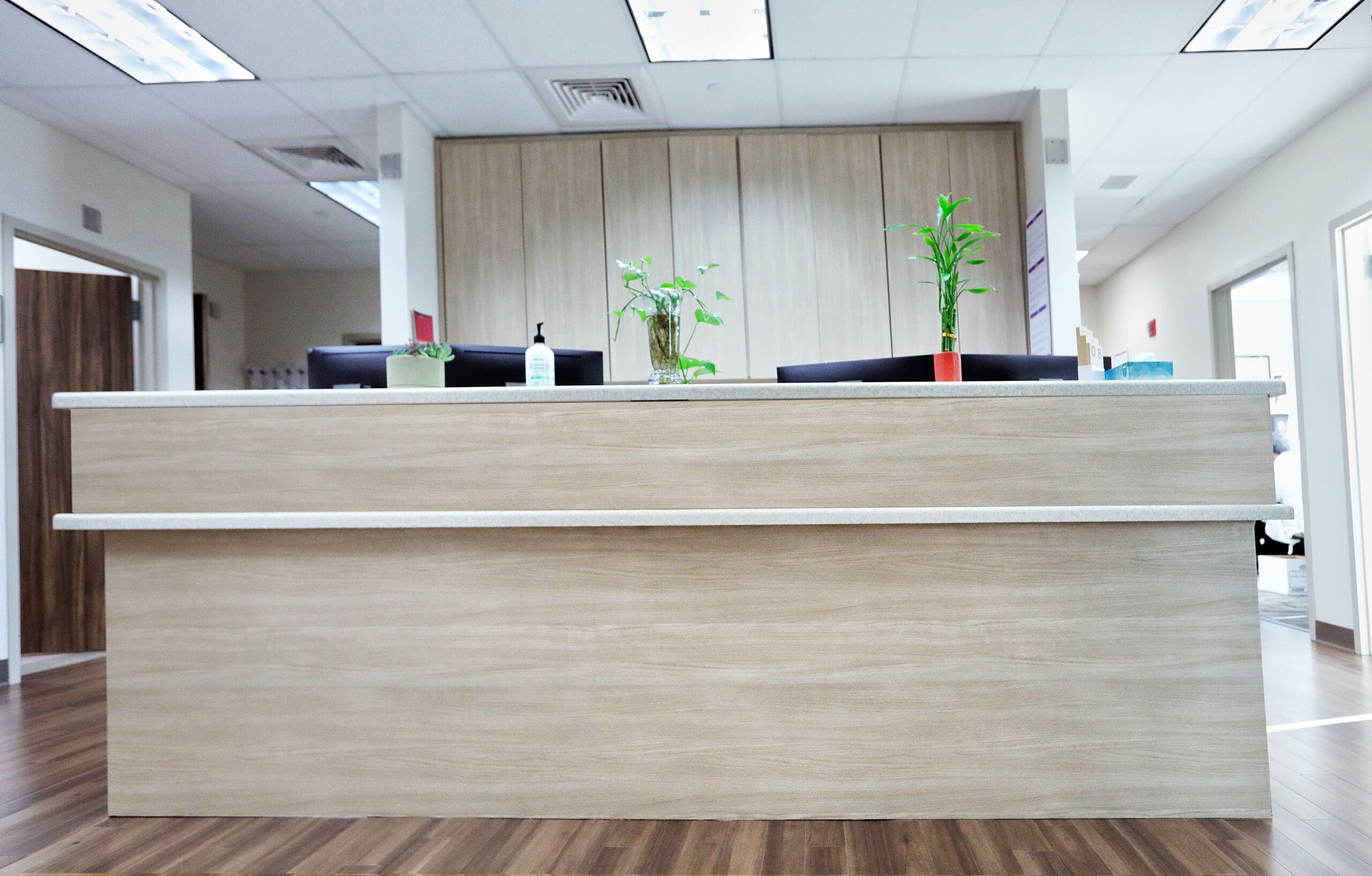
The list of refinishable surfaces is longer than most facility teams expect. Engineered Group applies architectural films across walls and ceilings, patient-room and corridor doors, headwall panels, nurse-station casework, exam-room millwork, and lobby columns. Elevator cab interiors, which take constant abuse from carts and gurneys and are expensive to replace, refinish in place over a weekend so a single car is out of service only briefly. Wood grains, stone looks, solid colors, and metal finishes are all available, with more than 1,000 patterns to specify, so a renovation can match a health system’s brand standards without custom fabrication.
How much does hospital renovation cost, and where do the savings come from?
Engineered Group reports that resurfacing an interior surface can cost up to 60 percent less than removing and replacing it, and that the finished result carries about a 12-year interior life. Those numbers come from the company’s own healthcare and commercial projects across Florida, and they hold up for one structural reason: refinishing removes the two most expensive lines in a renovation budget, demolition and new materials.
The savings compound in ways a line-item quote does not always show. An occupied wing that stays open keeps generating revenue during the work. A refinishing job measured in days rather than weeks shortens the period when a corridor is cordoned off. And a Class A fire-rated, nonporous finish that lasts more than a decade pushes the next replacement cycle far into the future. For a health system weighing capital projects against a rising average age of plant, refinishing frees budget for the structural work only a general contractor can do.
How to choose a hospital renovation company in Orlando
Engineered Group represents five specialty finish lines and more than 1,000 patterns, and it holds 3M authorized installer status along with LEED and ASID credentials. Those markers are a useful checklist when you evaluate any Orlando hospital renovation company.
Ask four questions before you sign. First, is the installer manufacturer-authorized, so the warranty on the film is real? Second, can the company show healthcare references, occupied facilities where it worked around patients and staff? Third, does the proposal include an infection-control and containment plan, not just a color and a price? Fourth, do the finishes meet clinical requirements for fire rating, cleanability, and durability in high-traffic corridors? Engineered Group has answered those questions on projects for Florida healthcare, hospitality, and commercial clients since 2002, and it serves Orlando and the wider state from its base in Sanford. When you are ready to scope a project, you can reach the Engineered Group team for a walkthrough and estimate.
Frequently Asked Questions
Can a hospital stay open during a surface renovation?
Yes. Refinishing works on the existing surface with no demolition, no construction dust, and no VOCs, so a corridor, lobby, or department can keep operating while the crew works. That is the core reason occupied hospitals choose architectural films over tear-out replacement.
Are architectural finishes safe for a healthcare environment?
The films are nonporous and clean with a non-abrasive cleaner or hot water, which matches hospital cleaning protocols. Refinished door products carry an anti-microbial surface and a Class A fire rating. A renovation still needs an infection-control risk assessment, but a dustless method greatly reduces the airborne risk that construction normally creates.
How long does hospital surface refinishing take?
Most projects run from a few days to a week or two, depending on square footage and access. An elevator cab interior often refinishes over a single weekend, so the car is out of service only briefly rather than for the weeks a full replacement would require.
How much can a hospital save by refinishing instead of replacing?
Engineered Group reports that clients typically save up to 60 percent compared with removing and replacing a surface, because refinishing eliminates demolition and new-material costs. The finished interior carries about a 12-year life, which also delays the next replacement cycle.
Does Engineered Group serve hospitals outside Orlando?
Yes. Engineered Group is based in Sanford and works statewide across Florida, serving healthcare, hospitality, commercial office, and construction clients from Orlando to Miami, Tampa, and Fort Lauderdale.
Engineered Group · 3930 St Johns Pkwy, Sanford, FL 32771 · (407) 802-3345 · Serving Orlando and Florida statewide since 2002.