

September 29, 2026
Column wrapping in Orlando, FL is the fastest way to give a dated lobby, parking-deck or retail column a new wood, stone or metal look without tearing it out. Instead of demolishing and rebuilding the column, a contractor bonds a thin architectural film directly over the existing surface. For property managers and designers across Central Florida, that difference decides how long the space stays closed, how much the project costs and how much debris leaves the building. Columns are usually one surface in a wider commercial interior resurfacing scope, and they are often the first one a guest sees up close.
This guide explains what column wrapping is, which materials hold up in high-traffic commercial buildings, how the process runs and what drives the price in the Orlando market.
Key Takeaways
- Column wrapping bonds a thin architectural film over an existing column, so there is no demolition, no construction dust, no VOCs and no operational downtime.
- Clients typically save up to 60% versus tearing a column out and replacing it, because the structure and substrate stay in place.
- Engineered Group specifies a 12 year interior lifespan for the film; it cleans with a non-abrasive cleaner or hot water and can be repaired so the patch is not visible.
- Round, square and tight-radius columns can all be wrapped, with 1,000+ wood, stone and metal patterns to specify from.
- In a market that welcomed 75.3 million visitors in 2024, a refreshed lobby column protects the first impression Orlando properties compete on.
What is column wrapping?
Column wrapping is the process of bonding a thin architectural film directly over an existing column so it takes on a new finish, such as woodgrain, stone or brushed metal, without any demolition. The film is applied on site to the surface you already have, which means the column keeps its structural core and only its appearance changes. Engineered Group installs these wraps on round, square and tight-radius columns using material lines including 3M Di-Noc, Koroseal Reatec, Belbien, LX Benif and Samsung SOIF.
That approach separates wrapping from two more disruptive alternatives. Full replacement removes the column cladding or the column itself and rebuilds it, which is slow and expensive. Traditional cladding fastens new rigid panels over the column, which adds bulk and often needs brackets the substrate cannot always carry. Wrapping keeps the existing profile and adds a durable, specified finish instead. You can see the full scope on the Engineered Group column refinishing service page.
Why Orlando businesses wrap columns instead of replacing them
Avoiding tear-out is not only faster, it keeps material out of the landfill. The U.S. Environmental Protection Agency reports that 600 million tons of construction and demolition debris were generated in the United States in 2018, with roughly 144 million tons sent to landfill that year. A column that is refinished rather than demolished never enters that waste stream at all.
The cost math is just as direct. Clients typically save up to 60% on an architectural finishes project compared with tearing the surface out and replacing it, because the labor, structure and substrate all stay in place. Just as important for an occupied building, wrapping runs with very little disruption: no demolition, no construction dust, no VOCs and no operational downtime. A hotel lobby, a medical office or a retail floor can stay open while columns are refinished a few at a time. Engineered Group works across the region, and its architectural finishes in Orlando cover columns alongside walls, elevators and doors.
What materials and finishes work best for column wraps
The finish library is deep: there are 1,000+ patterns to specify from, spanning wood, stone and metal effects that read as the real material from arm’s length. For a designer matching a column to new millwork or a stone feature wall, that range is usually the deciding factor over a painted or clad alternative. If you are still choosing a look, our post on modern column wrap ideas for healthcare facilities and offices works through patterns by building type.
Material performance matters as much as looks in a commercial column. 3M Di-Noc holds an ASTM E84 Class A fire rating, the top interior classification for flame spread and smoke development, which is what specifiers ask for in lobbies and corridors. Engineered Group is a 3M authorized installer, and Di-Noc is a common choice for columns because it conforms to curves and tight radii that rigid panels cannot follow. Koroseal Reatec resurfaces curves, corners and three-dimensional surfaces and meets California Indoor Air Quality Specification 01350, which matters on healthcare and school work. Belbien, LX Benif and Samsung SOIF widen the pattern and texture options further.
Specify from
What you can put on a commercial column
Wrapping competes with cladding on range, not just price: the film conforms to curves and tight radii that rigid panels cannot follow.
1,000+
wood, stone and metal patterns to specify from
5 lines
installed: 3M Di-Noc, Koroseal Reatec, Belbien, LX Benif and Samsung SOIF
Class A
ASTM E84 fire rating held by 3M Di-Noc film
How durable is a wrapped column?
A wrapped column is built to survive a busy commercial environment. Engineered Group specifies a 12 year interior lifespan for the film, and the finished surface resists water, dirt and normal wear well. Day-to-day maintenance is simple: the material can be cleaned with a non-abrasive cleaner or hot water, so a facilities team can keep it looking new without special products.
Repairability is the quiet advantage over paint or laminate. If the material does chip or scratch, it can be repaired so that you cannot tell where the patch is. That matters on a column at a building entrance or an elevator lobby, where a cart or a corner impact is a question of when, not if. Instead of repainting a whole column or replacing a damaged panel, the affected area is patched and the finish is restored. You can review the broader capability on the architectural finishes overview.
What does the column wrapping process look like?
Column wrapping is a dry, low-impact process from start to finish. There is no wet demolition and no long shutdown, which is why the building can stay open while the work happens. The steps are consistent across most commercial columns:
- Assess and measure the column, confirming shape (round, square or tight-radius) and surface condition.
- Help the client specify a pattern from the wood, stone and metal options that fits the design intent.
- Clean and prepare the existing surface so the film bonds correctly.
- Cut and apply the architectural film on site, conforming it to the column profile.
- Finish the seams and edges, then inspect for a clean, uniform result.
Because the film is applied to the surface you already have, a phased schedule is easy to arrange. Crews can wrap columns floor by floor or after hours so tenants and visitors are never locked out of the space.
How much does column wrapping cost in Orlando?
The headline number is the savings: column wrapping typically costs up to 60% less than a full replacement of the same column finish. The exact price depends on a handful of factors rather than a flat rate. Column count and size set the base scope. Column geometry matters too, since tight-radius and fluted columns take more careful application than a simple square. Pattern selection can shift material cost, and site conditions, such as ceiling height or the need for after-hours work, affect labor.
The value case is strongest on aging building stock, and there is a lot of it. The U.S. Energy Information Administration counts roughly 5.9 million commercial buildings in the country as of its 2018 survey, a large share of them decades old and due for interior updates. Refinishing the columns in those buildings, rather than rebuilding them, is how owners modernize a lobby on a renovation budget instead of a construction budget. Estimates from Engineered Group are free, and a walk-through gives you a real number for your building rather than a range.
Column wrapping for Orlando’s hospitality, retail and office market
First impressions carry real weight in a destination this busy. Visit Orlando reports that the region welcomed 75,333,800 visitors in 2024, an increase of 1.8% that kept Orlando the most-visited destination in the United States. Hotel lobbies, resort common areas, convention-adjacent retail and Class A office towers all compete on how polished that entry space feels, and columns are often the first vertical surface a guest sees up close.
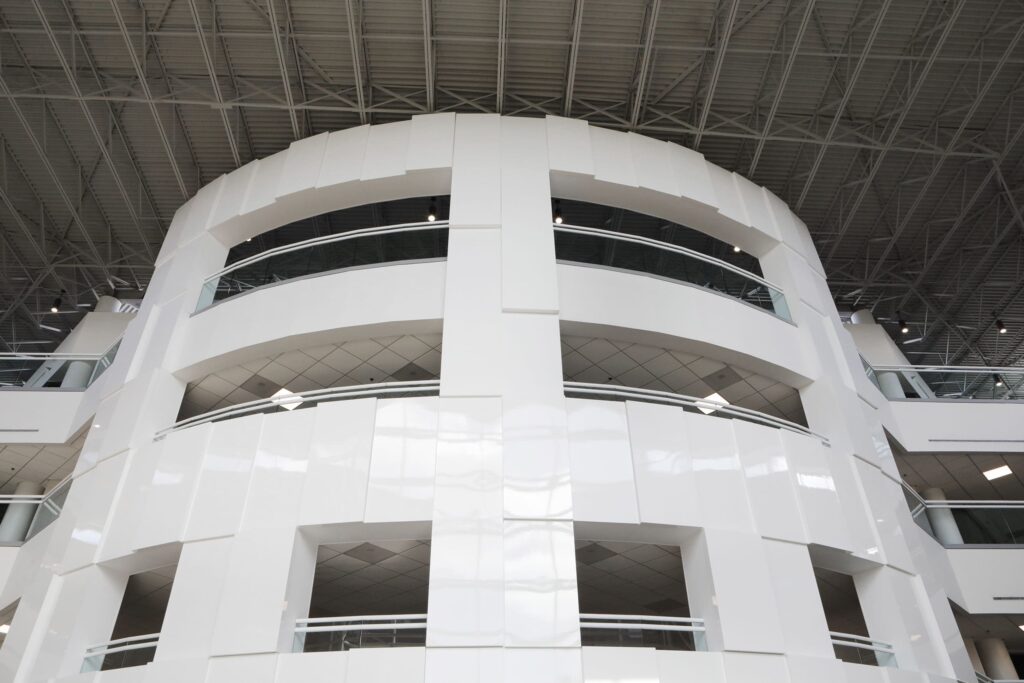
Engineered Group has delivered exactly this kind of interior refresh in the Orlando area. At The Maitland Colonnades, a four-story Class A office building of roughly 260,000 rentable square feet, the team modernized a dated interior feature, including a 60-foot by 60-foot granite wall, at a fraction of the cost the client expected from traditional renovation. The same film systems and dry-application methods that transformed that space apply directly to columns, which is why wrapping is a repeatable, budget-friendly way to keep Central Florida commercial interiors current.
Columns wrapped across Florida, not only Orlando
Engineered Group self-performs statewide in Florida, so a portfolio owner does not need a different contractor in every market. Column work runs on the same crews and the same specification in Tampa, Jacksonville and Miami, and in Fort Lauderdale, West Palm Beach, Sarasota, Naples, Fort Myers, Daytona Beach and Tallahassee. For multi-site hospitality and office groups, that is what keeps a lobby standard consistent from one building to the next.
Frequently asked questions
Is column wrapping the same as painting a column?
No. Painting recoats the existing surface with a color, while column wrapping bonds an architectural film that carries a full wood, stone or metal pattern and texture. The film resists water, dirt and normal wear, and if it chips or scratches it can be repaired so that you cannot tell where the patch is.
Can any shape of column be wrapped?
Round, square and tight-radius columns can all be wrapped. Architectural film can resurface curves, corners and three-dimensional surfaces, which is why it works on fluted and radiused columns that rigid cladding panels cannot follow.
How long does a wrapped column last?
Engineered Group specifies a 12 year interior lifespan for the film. It resists water, dirt and normal wear, cleans with a non-abrasive cleaner or hot water, and can be repaired so the patch is not visible.
Will my building have to close during the work?
No. The film is applied on site to the surface you already have, so there is no demolition, no construction dust, no VOCs and no operational downtime. Crews commonly phase the work floor by floor or after hours.
How much can I save versus replacing the columns?
Clients typically save up to 60% on an architectural finishes project compared with tearing the surface out and replacing it, because the structure and substrate stay in place. The exact figure depends on the surface and the scope.
Book a walk-through of your columns
If you have an Orlando or Central Florida lobby, parking deck or retail floor with columns that look tired but are structurally sound, wrapping is the faster and cheaper path. Contact Engineered Group or call (407) 802-3345 to book a walk-through. Estimates are free, and the team will come back with finishes, a budget range and a sample you can hold against the column.