Decorative glass film is a printed or frosted polyester layer applied to glass you already own. It buys privacy, pattern and branding on a conference room, a corridor wall or a storefront without a glazier, a lead time or a replacement pane. The product is straightforward. Specifying it is where projects go sideways — which face of the glass, how much privacy, where the pattern stops. This guide covers what the film is, the three other films it gets confused with, and the decisions an estimate in Orlando needs you to have already made.
Key takeaways
- It goes on the glass already in the frame. Engineered Group states that the finish applies to most new or existing glass, needs no extra hardware or setup, and needs no added maintenance or special cleaning.
- Privacy without a dark room. The stated point of the 3M Fasara range is design and privacy “without losing the beauty of natural light or creating a sense of closure.”
- It is an interior-glass product. 3M’s own technical data sheet says most Fasara products are designed for application to building interior glass, including the interior face of an outside glass wall.
- It is not solar, security or anti-graffiti film. Four different films do four different jobs on the same pane, and specifying the wrong one is the most common error on a glass package.
- Reversible by design. As needs change, the film can be changed too. That is why it suits tenant fit-outs and leased floors in Orlando.
What decorative glass film actually is
Strip the marketing off and it is a thin material with a known construction. Engineered Group describes the film it installs as a durable polyester film, non-PVC, with a pressure-sensitive adhesive backing, printed to a consistent appearance with durable inks. It is cut to the opening, wetted out onto the glass and squeegeed down. No frame is touched.
The product line behind most of this work is 3M Fasara Glass Finishes, which Engineered Group installs as its decorative glass offer. The company’s own count is more than 100 unique designs, patterns and textures, grouped on its page into two families:
- Frost and Matte. Even obscuration across the pane, in varying densities. Patterns named on the range include Milano, Frosted Crystal, Altair, Yamato and Milky Crystal.
- Gradation. Density that changes across the sheet, so a pane can be opaque at seated eye level and clear above it. Named patterns include Illumina, Illumina Silver, Venetian, Tsurugi, Sabrina and Lontano.
The comparison that matters is not film against plain glass. It is film against the alternative way of getting the same look: ordering etched, sandblasted or laminated decorative glass. That route is a fabrication job with a measure, a lead time, a delivery and a glazing crew. Engineered Group’s position on the finishes is that they give the look and translucency of textured decorative glass at a fraction of the cost, and they do it on the pane that is already hanging.
The four films that go on the same pane
A building owner asking for “window film” usually means one of four products, and they are not interchangeable. Engineered Group’s window film range is solar, safety, privacy and decorative film for the glass you already have, installed as an authorized 3M window film dealer. Here is what each one is actually for.
| Film | The problem it solves | What you see | Where it usually goes |
|---|---|---|---|
| Decorative glass finish | A room that should be private is on full view | Frost, pattern or gradation; the view is deliberately obscured | Interior partitions, conference rooms, office fronts, door glass |
| Sun control film | Heat gain, glare and fading on sun-facing glass | Little; the view and the daylight both stay | Exterior-facing glazing, atriums, west and south elevations |
| Safety and security film | Glass that leaves the frame under impact, storm or forced entry | Nothing; it stays clear | Ground-floor and entrance glazing, lobbies, exposed elevations |
| Anti-graffiti film | Tagging, scratching and etching on reachable surfaces | Nothing, until it is stripped off | Street-level glass, mirrors, stainless cladding |
The four coexist on one building and often on one schedule. A medical office in Orlando can take a decorative finish on the exam-room glazing, sun control film on the west elevation, safety and security film on the entrance, and anti-graffiti film on the restroom mirrors. One crew, one mobilization. What you must not do is let a single line item called “window film” carry all four, because the bids that come back will not be comparable.
Where it goes in an Orlando building
Engineered Group names its decorative glass applications as offices, hotels, retail stores, restaurants and healthcare environments. On Central Florida commercial property, that resolves to a fairly predictable set of openings:
- Conference rooms and huddle rooms. The classic case: a glass box that needs to stop being a fishbowl without losing daylight to the floor plate behind it.
- Glass office fronts and demountable partitions. Increasingly the standard fit-out in Orlando office product, and increasingly the reason a tenant asks for privacy on day one.
- Exam rooms, reception screens and lab glazing. In a healthcare interior, obscuration at the right height is a patient-privacy question before it is a design question.
- Hotel meeting space, spa and pre-function glazing. In hospitality work, the same glass has to look considered from the corridor and give privacy from the room.
- Restaurant dividers and banquette screens. Pattern that separates covers without building a wall.
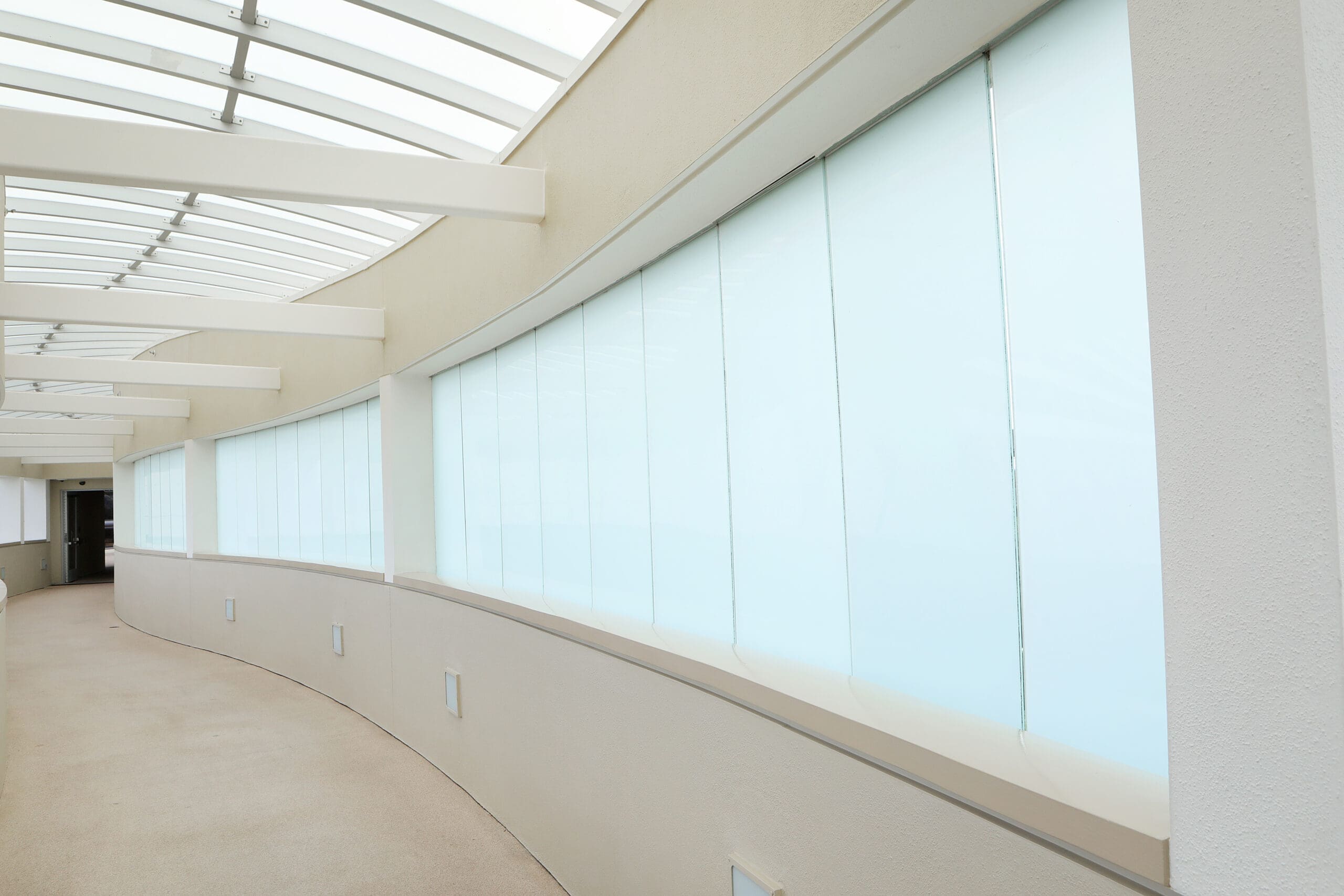
- Corridor and atrium glass walls. Long runs where a gradation reads as architecture rather than as a sticker.
- Door glass and sidelights. Small areas, high scrutiny, and the place a mismatched pattern is most obvious.
Engineered Group’s own decorative glass work includes an Orlando glass-and-walls project for Barton Malow, listed on its Fasara page alongside Hard Rock and Visit Orlando. The company works throughout Florida, statewide, from single-site jobs to multi-building campuses, and runs out of Sanford, twenty-odd miles up I-4 from downtown Orlando.
Five decisions your estimate needs
Most of the friction on a decorative glass package comes from decisions nobody made. These five settle it.
1. How much privacy, measured in what you can still see
“Frosted” is not a specification. Density ranges from a light haze that blurs movement to a finish you cannot read a whiteboard through. Decide it by standing in the corridor and naming what should still be legible: a body shape, yes; a face, no; the text on a monitor, definitely not. That sentence is worth more to an estimator than a pattern name.
2. Which face of the glass the film goes on
This is the decision people skip, and it is the one with a published answer. 3M’s technical data sheet for Fasara Glass Finishes states that most products in the range are designed for application to building interior glass, which includes the interior face of an outside glass wall. The installation guide recommends the same two surfaces. A handful of items in the catalog are listed for exterior use, so the governing document is the data sheet for the exact product, not the family. On an interior partition the question becomes which room gets the smooth side, and the answer is usually the side that gets cleaned hardest.
3. Where the pattern starts and stops
A privacy band has a top and a bottom, and both are sightline decisions rather than aesthetic ones. Seated eye level and standing eye level are different heights, and a band set for one fails the other. Decide whether the film runs full-height, stops at a head rail, or returns around a corner, and whether adjacent panes have to align. Misaligned bands between two panels are the single most visible defect in finished work.
4. What is already on the glass
Film needs a smooth, solid, non-porous surface to bond to. Existing film has to come off first. Low-emissivity coatings, laminated units, tempered panes with roller distortion and surface-applied muntins all change the answer, and all of them are easier to resolve at the site visit than on installation day. Say what the glass is if you know, and let the estimator look if you do not.
5. How long the tenant is staying
Engineered Group’s stated position is that the finish applies to most new or existing glass, requires no extra hardware or setup, needs no added maintenance or special cleaning, and that as needs change it can be changed too. On a five-year lease with a logo in the pattern, that reversibility is the whole argument for film over fabricated glass.
What the finish buys you
Four numbers behind a decorative glass package
Figures published by Engineered Group for its decorative glass finishes.
100+
Unique 3M Fasara designs, patterns and textures to specify from
Up to 60%
Saved against the cost of a full renovation of the surface
0
Panes replaced; the finish goes on the glass already in the frame
Free
Cost of an estimate, which comes back with a sample of the finish
Source: Engineered Group, decorative glass finishes and 3M Fasara pages, engineeredgroup.com.
Branding and wayfinding on the same glass
Once a glass wall is getting a finish, it is worth asking the second question: should it also say something? A privacy band and a wayfinding system occupy the same real estate, and specifying them separately usually means paying to visit the same pane twice.
Engineered Group runs environmental graphics as its own line, which is where logos, room numbers, donor walls and floor identity live. The practical rule is to decide the privacy density first and the graphic second, because a graphic reads very differently over a dense frost than over a light haze. If you want ideas rather than specification, the company’s piece on custom decorative glass for commercial interiors covers the design side.
Cleaning it, and changing it
Decorative glass film needs no added maintenance or special cleaning, which is the claim Engineered Group makes on its own page and the one most owners want tested. In practice the film is cleaned as the rest of the glass line is cleaned: a common window cleaning solution, a soft cloth or clean synthetic sponge, and a soft squeegee. Bristle brushes, abrasives and heavy pressure are what damage film, not daily use.
The other half of the maintenance question is change. Film is fitted pane by pane, so a department that moves, a tenant that leaves or a brand that refreshes affects only the panes involved. Refreshing rather than replacing glass also keeps material out of landfill, and Engineered Group notes that it can earn LEED credits, including for low-emissions materials.
What an estimate gives you
Estimates from Engineered Group are completely free. Describe the surface and the scope and you get a real number back, along with a sample of the finish — which matters more on decorative glass than on any other film, because a frost density looks different on a sample card, on a screen and on your actual glazing in your actual light.
Bring three things to that conversation: the openings you want treated, the privacy sentence from decision one, and whether the same visit should pick up anything else. Most buildings have more than glass on the list. If the walls, columns, doors or elevator interiors are also tired, the same crew handles them under architectural finishes in Orlando, and renewing an existing surface rather than replacing it saves up to 60% against a full renovation. If the ground-floor glass is getting marked rather than overlooked, the anti-graffiti film guide covers that case. Engineered Group is at 3930 St Johns Pkwy, Sanford, FL 32771, and can be reached on (407) 802-3345.
Frequently asked questions
What is decorative glass film?
A durable polyester film, non-PVC, with a pressure-sensitive adhesive backing, printed to a consistent appearance with durable inks, applied to glass you already have. It gives the look and translucency of textured decorative glass at a fraction of the cost.
How many 3M Fasara designs are there?
More than 100 unique designs, patterns and textures, grouped into families including Frost and Matte and Gradation.
Can decorative glass film go on the outside of a window?
Usually not. 3M’s technical data sheet says most Fasara products are designed for application to building interior glass, including the interior face of an outside glass wall. A small number of items are listed for exterior use, so check the data sheet for the specific product before specifying it.
Does it need special cleaning?
No. It applies to most new or existing glass, requires no extra hardware or setup, and needs no added maintenance or special cleaning. Avoid bristle brushes, abrasive materials and heavy pressure.
Can it be removed if the tenant changes?
Yes. The film is fitted pane by pane and, as needs change, it can be changed too. That is a large part of why it is specified on leased floors.
What does decorative glass film cost in Orlando?
It depends on the openings, the glass and the pattern. Estimates are completely free: describe the surface and the scope and you get a real number back, along with a sample of the finish.