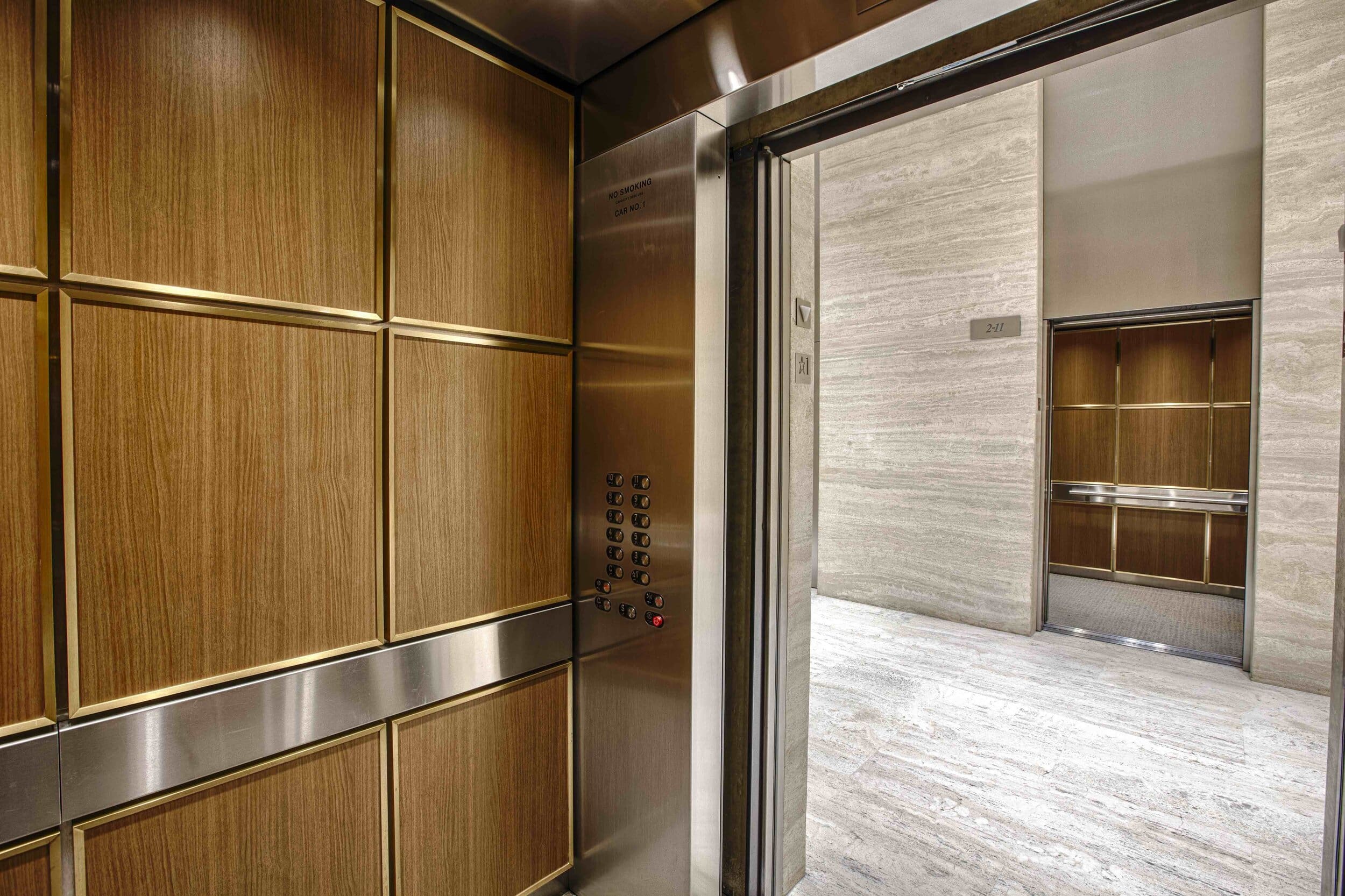
An elevator cab interior is not one surface. It is a set of them: the side and rear wall panels, the front return and the cab doors, the ceiling, the handrail and base, the floor, and the hall doors at every landing. Each one is a different material in a different condition, and each one gets a different answer when you ask whether it can be refinished where it stands. This guide takes them one at a time, names the finish lines that go on them, and sets out what a cab interior specification has to say before anyone can price it properly.
Key takeaways
- A cab interior is six or seven surfaces, not one. Panels, cab doors, front return, hall doors and frames, ceiling, handrail and base, and the floor. Price them as separate lines.
- The test for refinishing is the substrate, not the surface’s age. Architectural film goes on surfaces that are smooth, solid and non-porous — walls, ceilings, elevators, columns, doors, millwork, casework and glass.
- The panels stay in the car. The finish is applied to the existing cab walls and doors on site, so there is no demolition and no waiting on replacement panels.
- Four finish lines, over 1,000 patterns. 3M Di-Noc, Belbien, Koroseal Reatec and LX Benif, in three-dimensional textures that reflect light and feel like the material they imitate.
- The floor is somebody else’s line item. Say so in the specification, or two bids will arrive that are not the same job.
What counts as the cab interior
Ask three people in a building what the elevator interior is and you get three answers. The facilities manager means the panels that get kicked. The architect means the whole visible assembly, including the hall doors on the lobby level. The elevator contractor means the car enclosure, which is a code term and not a finish schedule.
For refinishing, the useful boundary is the one Engineered Group uses on its elevator cab refinishing work: cab walls, doors and surrounds. That is the set of surfaces a passenger stands in front of for the length of the ride, and the set that can be resurfaced without pulling the car out of service for a rebuild. Everything mechanical — controller, drive, hoistway, door operator — sits outside it and belongs to the elevator contractor.
The test for any individual surface is the substrate. Architectural film needs a surface that is smooth, solid and non-porous. That takes in walls, ceilings, furniture, elevators, columns, doors, millwork, casework and glass. A dented panel, a delaminating edge or a missing piece is a repair question first and a finish question second.
Surface by surface
Here is the cab broken into the lines a specification should carry, with the honest answer about film rather than a sales answer: most of these surfaces are in, one is a decision for the site visit, and one is not a film surface at all.
Side and rear wall panels
Flat, framed panels — most often laminate, painted metal or a wood veneer.
Takes architectural film: Yes, where the panel is smooth, solid and non-porous.
In the specification: Finish line and pattern number, and whether the frames and reveals are in scope too.
Cab doors and the front return
The two surfaces every passenger looks at while waiting and while riding.
Takes architectural film: Yes. This is the surface Engineered Group names first on its elevator work.
In the specification: Class A fire-rated film where the doors are in scope, and a matte or gloss decision.
Hall doors and frames at each landing
Outside the car, repeated on every floor, and usually the most scratched metal in the building.
Takes architectural film: Yes — the published scope is cab walls, doors and surrounds.
In the specification: How many landings, and whether the frames and sills are included or left.
Cab ceiling
A hard ceiling or a paneled grid carrying the light fixture.
Takes architectural film: Yes on hard ceilings and paneling. The light fixture itself is not a finish surface.
In the specification: Whether the ceiling is in scope at all, and who removes and refits the fixture.
Handrail, base and trim
Hardware rather than paneling, often stainless, often fixed through the panel behind it.
Takes architectural film: Decide on the site visit. Some are refinished, some are left, some are replaced by others.
In the specification: A line saying which, so it is not discovered on the day the crew arrives.
Cab floor
Resilient flooring, stone or carpet tile, and a different trade.
Takes architectural film: No. The film goes on vertical and overhead surfaces, not the floor you walk on.
In the specification: Exclude it in writing, or the bid you compare will not be comparing the same job.
The entry that saves the most argument later is the last one. A cab floor is a different trade on a different schedule, and a bid that quietly includes or excludes it is the reason two numbers for the same car can differ by thousands.
The finish lines, and what the choice changes
Engineered Group installs four lines on elevators: 3M Di-Noc, Belbien, Koroseal Reatec and LX Benif. Between them they run to over 1,000 patterns in wood, stone, textile and metal, and the three-dimensional texture in each one reflects light and feels like the material it imitates rather than like a printed sheet.
Two parts of the choice have consequences beyond appearance. The first is fire performance: the architectural doors Engineered Group resurfaces are Class A fire rated, and the material is also available with built-in anti-microbial protection, which is why it turns up in hospitals, physicians’ offices and commercial kitchens. The elevator code has carried a rule on the materials used in car enclosures, enclosure linings and floor coverings for decades — California’s elevator authority maps its own section straight onto ASME A17.1 Rule 204.2a, which covers exactly that — so the fire rating is not a nice-to-have line in the spec. Which edition applies is a question for your jurisdiction and your elevator contractor; having published fire-performance data for the finish is your side of it.
The second is gloss. A cab is the one room in a building where every passenger stands within arm’s reach of a wall for thirty seconds at a time, usually holding a phone or a coffee. Gloss level decides how that cab looks between cleans, not only on the day it is handed over.
What the finish buys you
Four numbers that decide the cab interior spec
The film goes over the panels you already own, which is where the cost and the schedule both change.
Up to 60%
Typical saving against the expected cost of replacing the cab interior
12 years
Interior lifespan of the architectural film, and 5 years outdoors
1,000+
Patterns to specify from, in wood, stone and metal
Under an hour
What the film takes on a single door leaf
Source: Engineered Group, elevator and commercial door refinishing pages.
The saving is the headline, but the schedule is what usually decides it. Replacement panels are made to size, shipped, and fitted on a date somebody else controls. Film is applied to the panels already hanging in the car.
Fingerprints are a finish decision, not a cleaning problem
The matte surface Engineered Group specifies on cab walls and doors converts incident light into diffuse reflection. In plain terms: very low gloss, a deep matte texture, and noticeably fewer visible fingerprints than a conventional gloss panel, on a surface that is easy to maintain.
That matters most on the two surfaces nobody can avoid touching — the front return around the car operating panel, and the cab doors. If the current cab has polished stainless there, the cleaning crew is fighting physics every morning. Changing the gloss level changes the amount of cleaning the finish needs for the next decade, which is a running cost, not a one-off.
Durability runs the same way. The film is a micro-overlay, and a chip or scratch can be patched so you cannot tell where the repair is. That is a different maintenance model from a laminate panel, where a damaged panel is replaced as a unit and the replacement rarely matches the ones either side of it.
What a cab interior specification should state
If you want comparable bids, the document needs to answer these before it goes out:
- Which surfaces are in scope. Walls, cab doors, front return, hall doors and frames, ceiling, handrail, base. One line each, in or out.
- How many landings. Hall doors and frames repeat on every floor, and they are often the larger half of the work.
- The finish line and the pattern number, plus the gloss level, and a physical sample approved before the schedule is set. Engineered Group’s estimates come back with a sample of the finish.
- The fire rating required, with product data, and anti-microbial protection where the building calls for it.
- Substrate condition and who fixes it. Dents, delamination and missing trim are repairs, not finishes.
- Phasing. Which cars come out of service, in what order, and in which hours.
- Lifespan expectation. Up to 12 years indoors is the number to plan the next refresh against.
What the work looks like in a live building
The finish goes onto the cab walls and doors that are already there, so there is no demolition and nothing to order to size. On a door leaf, the film takes under an hour. There is no VOC exposure, no construction dust and no noise, which is why this work gets scheduled in buildings that cannot close: the lobby stays open and the other cars keep running.
That is also the practical difference between a refinish and a cab replacement. A replacement is a construction project with a lead time attached. A refinish is a sequence of short visits, car by car, that you can fit around the building’s own calendar. The companion piece on elevator cab renovation covers the refinish-or-replace decision itself in more detail.
Where these cabs are
The published elevator and elevator door projects include the Disney Contemporary Resort, Morgan & Morgan, Pier 66 and Barton Malow, and a refresh of the elevator doors at One Biscayne Tower in Miami. The elevator work is Florida, statewide, run from Sanford.
It also rarely stays in the cab. The same crew and the same finish lines cover commercial doors, columns, walls and ceilings and casework and built-ins, which is how a lobby ends up matching the cars that open onto it. The full range sits under architectural finishes.
Frequently asked questions
What is an elevator cab interior made of?
Treat it as separate surfaces rather than one finish: the side and rear wall panels, the front return and the cab doors, the ceiling, the handrail and base, the floor, and the hall doors and frames at each landing. Each is a different material in a different condition, so each gets its own line in the specification.
Can an elevator cab interior be refinished without replacing the panels?
Yes, where the surface is smooth, solid and non-porous. Engineered Group applies the finish to the existing cab walls and doors on site, so there is no demolition and no waiting on replacement panels.
How long does a refinished cab interior last?
Architectural film lasts up to 12 years indoors and 5 years outdoors. The material is a durable micro-overlay, and if it does chip or scratch it can be patched so you cannot tell where the repair is.
Are the finishes fire rated?
The architectural doors Engineered Group resurfaces are Class A fire rated, and the material is also available as an anti-microbial surface. Depending on the building and the scope, the work may qualify for LEED points.
How many finishes are there to choose from?
Over 1,000 patterns across the four lines Engineered Group installs on elevators: 3M Di-Noc, Belbien, Koroseal Reatec and LX Benif. The three-dimensional textures in each finish reflect light and feel like the real material.
Does Engineered Group only work in Orlando?
No. The elevator work is Florida, statewide, from the company’s base in Sanford. Published cab and elevator door projects include the Disney Contemporary Resort, Morgan & Morgan, Pier 66, Barton Malow and One Biscayne Tower in Miami.
If you have a set of cars with tired panels, the quickest way to a real number is to send the surfaces and the landing count. Estimates are free, and one comes back with a sample of the finish alongside the price. Contact Engineered Group to get the cabs looked at.