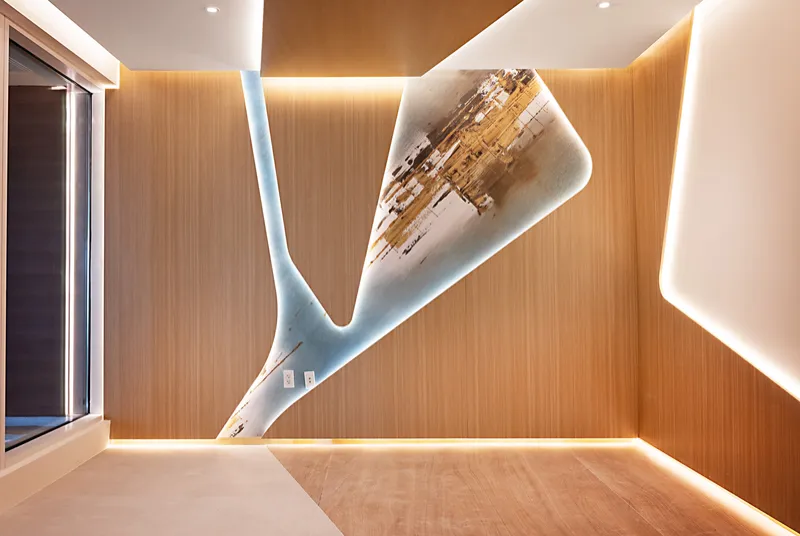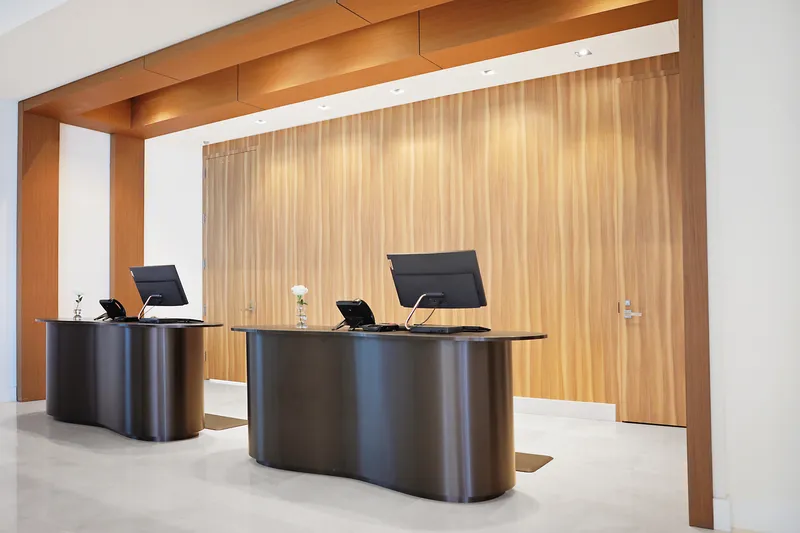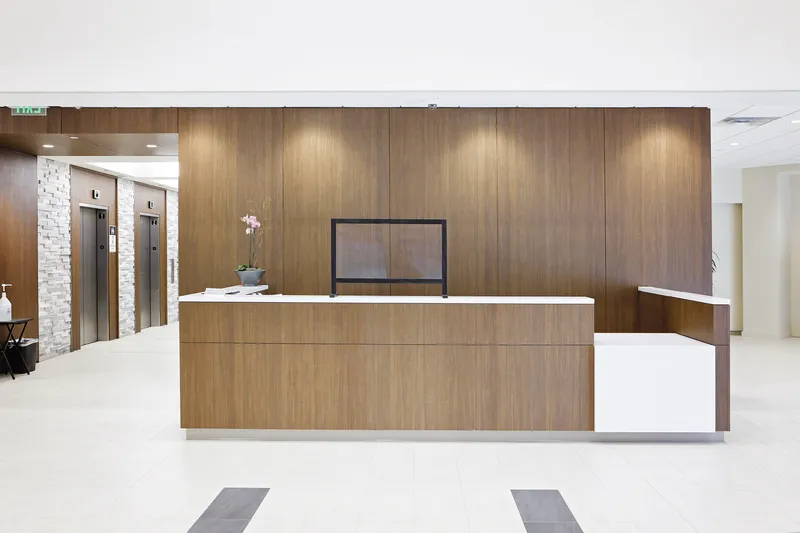
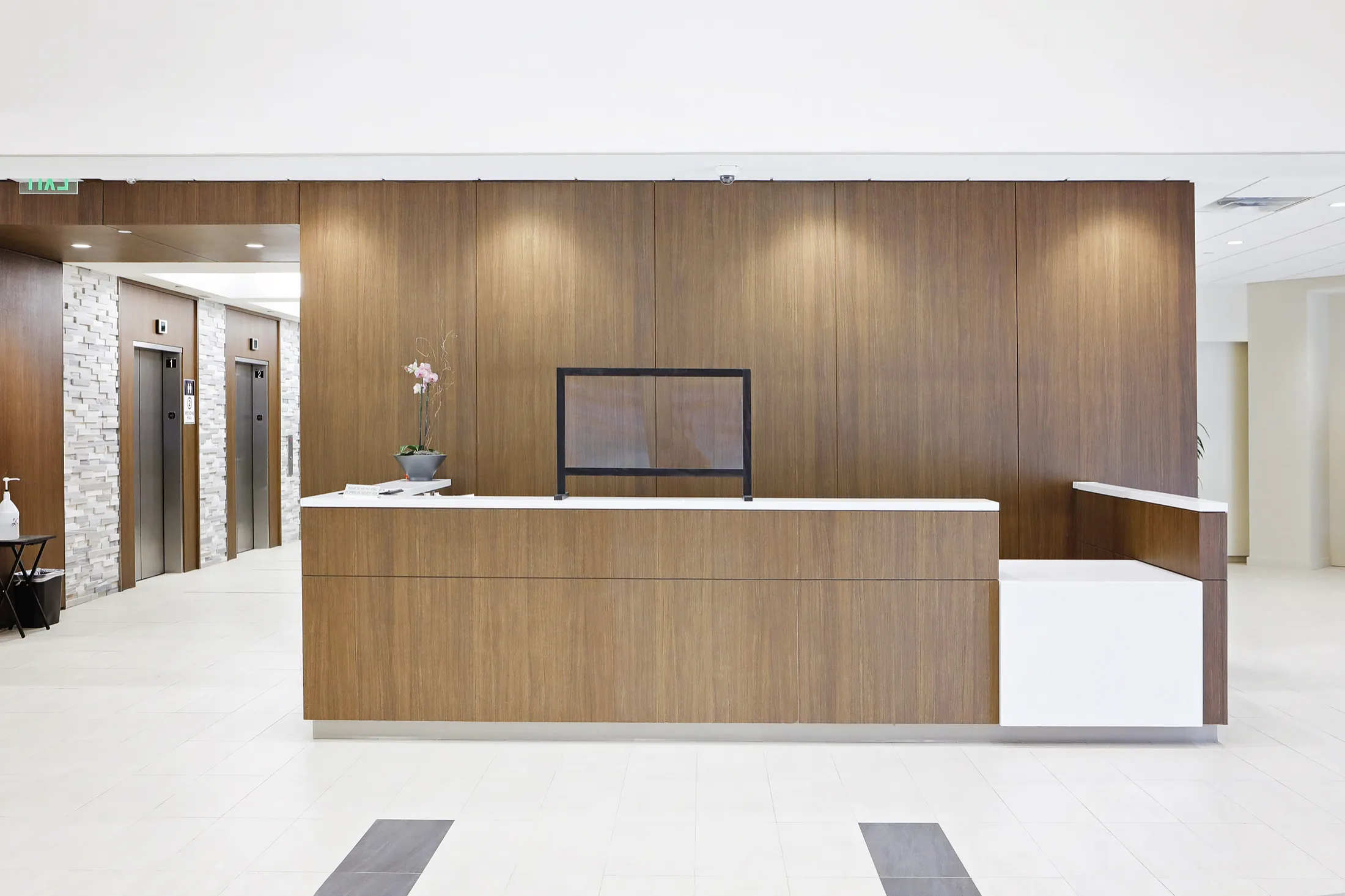
Millwork is the architectural woodwork that gives a commercial interior its character: the reception desk guests walk up to, the casework in a clinic, the built-in cabinetry in a conference room, the wood doors down a corridor and the paneling in a boardroom. When that woodwork looks dated or worn, the reflex is to rip it out and build new. Millwork refinishing offers a different route. It resurfaces the piece you already have with a micro-thin architectural film, matching the wood, stone or metal look you want without the cost, debris and downtime of replacement. This guide explains what the process covers, how it compares with sanding and restaining or full replacement, and what Orlando, Florida property owners and designers should weigh before they choose it.
Key takeaways
- Refinishing resurfaces the millwork in place. A micro-thin architectural film goes over reception desks, casework, cabinetry, paneling and wood doors, so the piece is never torn out and rebuilt.
- Clients typically save up to 60% against replacing the millwork, and the finish carries a 12-year interior lifespan with more than a thousand wood, stone and metal patterns to specify.
- The surface has to be smooth, solid and non-porous. Condition is checked during the free estimate, and any preparation is specified before work starts.
- Dry application, no paste, little disruption. For Orlando offices, hotels and medical buildings the work runs on your schedule, and the estimate comes back with finishes, a budget range and a sample.
What millwork refinishing actually means
The United States has roughly 5.9 million commercial buildings, according to the U.S. Energy Information Administration’s 2018 Commercial Buildings Energy Consumption Survey, and almost every one of them contains millwork that ages faster than the structure around it. Refinishing addresses that wear without replacement. A pressure-sensitive architectural film, a micro-thin surface material from lines such as 3M Di-Noc, Koroseal Reatec, Belbien, LX Benif and Samsung SOIF, is applied directly over the existing surface. The film recreates the look and feel of real wood grain, stone or metal through a matte coating combined with high-definition embossing, so a tired laminate reception desk or a scuffed run of cabinetry reads as new millwork once it is done.
This is not paint and it is not wallpaper. Architectural finishes from Engineered Group go on over the piece in place, which is what removes the cost and the lead time of building a replacement. The surface simply needs to be smooth, solid and non-porous. The finish resists water, dirt and normal wear, cleans up with a non-abrasive cleaner or plain hot water, and if it ever chips or scratches it can be repaired so you cannot tell where the patch is.
Refinish, sand and restain, or replace: the Orlando math
Orlando welcomed 76.7 million visitors in 2025, a 1.8% increase over the prior year and enough to keep it the most visited destination in the United States, according to Visit Orlando. That volume puts constant pressure on hotels, attractions, restaurants and the offices and clinics that serve them to look current, and it makes closing a lobby or a patient floor for a millwork rebuild genuinely expensive. The decision usually comes down to three options.
Sanding and restaining is the traditional refresh for solid wood, but it is messy, it releases dust and fumes into an occupied space, and it does nothing for the laminate and veneer surfaces that make up most modern commercial casework. Full replacement delivers new millwork but carries demolition, disposal, fabrication lead time and the labor of multiple trades, often with the space out of service the whole time. Refinishing with architectural film sits between them: the existing piece stays, the new surface goes on dry with no paste and little disruption, and the space can frequently stay open while the work is done. Engineered Group clients typically save up to 60% compared with tearing the surface out and replacing it, though the exact figure depends on the surface, the substrate and the size of the job, which is why the estimate is free.
What a millwork tear-out throws away
Construction and demolition work is the single largest source of waste in the country. The U.S. Environmental Protection Agency estimated that 600 million tons of construction and demolition debris were generated in the United States in 2018, more than twice the amount of municipal solid waste, and its figures show about 143.8 million tons of that debris went to landfill. Ripping out serviceable millwork feeds directly into that stream. Every reception desk, door and cabinet run that is refinished instead of demolished is material that never becomes debris.
The cost logic follows the same line. Replacement is not only the price of the new millwork; it is the demolition, the hauling, the disposal fees and the days the space cannot earn its keep. Refinishing collapses most of that into a single on-site operation. For an Orlando owner weighing a renovation budget across a portfolio of properties, the savings compound every time a surface is refreshed rather than rebuilt.
In-place refinishing and the skilled-labor question
The trade a replacement spec has to buy
US woodworkers, and what refinishing avoids
New custom millwork has to be fabricated by a trade that is getting smaller. Refinishing works with the piece already in the building.
Sources: U.S. Bureau of Labor Statistics, Occupational Outlook Handbook, woodworkers (2025); Engineered Group.
The trade that builds and replaces custom millwork is not growing. The U.S. Bureau of Labor Statistics counted about 199,900 woodworkers in 2025 and projects the occupation to decline 2% through 2035, with a median wage of $45,310 a year. Specifying all-new custom millwork means competing for that limited shop capacity and accepting the fabrication lead times that come with it. Refinishing the millwork you already own sidesteps that queue entirely, because nothing new has to be fabricated, delivered and installed. The crew works with the surfaces already in the building.
That matters most on projects where the millwork is tied to other interior surfaces. Engineered Group self-performs the whole interior surface package, so a lobby, its columns, its elevator cabs, its wood doors and its glazing can run on one schedule under one contractor instead of being split across trades that each have to be scheduled and coordinated.
Which millwork surfaces can be refinished
Architectural film can go on walls, ceilings, furniture, elevators, columns, doors, millwork, casework and glass, provided the surface is smooth, solid and non-porous. For millwork specifically, that covers the pieces a commercial interior relies on every day:
- Reception and front desks: the first surface a visitor sees, refreshed to current brand colors or wood tones without a custom rebuild.
- Casework and cabinetry: clinic, lab, break-room and office cabinetry resurfaced in place, including the casework, desks and built-ins that carry the heaviest daily use.
- Wood and fire-rated doors: corridor and suite doors refinished with a Class A fire-rated door film.
- Paneling and built-ins: boardroom walls, feature panels and reception millwork brought back to spec.
The finished surface is engineered to perform, not just to look right. The matte film converts incident light into diffuse reflection for very low gloss and a deep, realistic texture, resists fingerprints, and recreates an authentic tactile feel by pairing the matte coating with high-definition embossing. Real Central Florida work shows the range, from the front desk at Morgan & Morgan to the guest rooms and suites refreshed at the Four Seasons Resort Orlando.
How the process works on site
Engineered Group uses a dry application process, so there is no wallpaper paste involved. After the surface is cleaned and prepared, the film is positioned and adjusted before it is squeegeed down and any bubbles are smoothed out. Because the method is quick and clean, there is no demolition, no dust cloud and no stretch of days with the room torn apart. The film lasts up to 12 years indoors and 5 years outdoors, and because the install is straightforward, repairing or renewing it later is simple rather than a second renovation.
Engineered Group was established in 2002 and self-performs architectural finishes, decorative glass and window film across Florida, so an Orlando project and a sister property in another market can run to the same standard. You can see the full product range and service area on the Orlando architectural finishes hub.
Choosing a millwork refinishing contractor in Orlando
Three questions separate a durable result from a disappointing one. First, ask whether the installer is trained and certified for pressure-sensitive architectural film, because surface preparation, temperature control and hands-on experience decide the finish you end up with. Second, ask whether the company self-performs or subcontracts, since one team across desks, casework, doors and glass means one schedule and one point of responsibility. Third, ask whether they will put a physical sample of the exact finish in your hands before you commit. Engineered Group’s estimates are free, and the team comes back with finishes, a budget range and a sample, so you approve the look before any work begins.
When you are ready to compare refinishing against a rebuild for a specific space, contact Engineered Group with the surface and the scope and the team will come back with a real number and a sample of the finish.
Frequently Asked Questions
What is millwork refinishing?
Millwork refinishing resurfaces existing architectural woodwork, such as reception desks, casework, cabinetry, paneling and wood doors, with a micro-thin architectural film. The film recreates the look and feel of wood, stone or metal over the piece you already have, so the millwork is refreshed without being replaced.
Can you refinish millwork in place without removing it?
Yes. The film is applied to the existing piece where it stands, which is exactly what removes the cost and the lead time of building and installing a replacement. The surface only needs to be smooth, solid and non-porous.
How long does a refinished millwork surface last?
Architectural film lasts up to 12 years indoors and 5 years outdoors. It resists water, dirt and normal wear, cleans with a non-abrasive cleaner or hot water, and can be repaired so the patch is invisible if it is ever chipped or scratched.
How much does millwork refinishing cost compared with replacement?
Clients typically save up to 60% compared with tearing the surface out and replacing it. The exact figure depends on the surface, the substrate and the size of the job, so the estimate is free and comes back with a budget range and a sample.
Which wood surfaces can be refinished with architectural film?
Walls, ceilings, furniture, elevators, columns, doors, millwork, casework and glass can all take architectural film as long as the surface is smooth, solid and non-porous. That includes reception desks, cabinetry, built-ins, paneling and fire-rated wood doors.
How do I choose a millwork refinishing contractor in Orlando?
Confirm the installer is trained and certified for pressure-sensitive architectural film, ask whether they self-perform or subcontract the work, and require a physical sample of the exact finish before you commit. Engineered Group self-performs statewide in Florida, and the free estimate comes back with finishes, a budget range and a sample.